The Last Jedi: the feminist Star Wars we all needed and finally got

Last-Jedi-women-feminist

I am gonna go ahead and say it straight away: Episode VIII is now my favorite Star Wars movie out of the entire saga. How do I know so quickly? Because I cried through and through the entire movie, from beginning to end. I know I will cry as I write this. And as much as I enjoy Star Wars, none of the Episodes have made me have such a raw emotional response. Anyway. I have a LOT to say, so I’m gonna get down to business (spoilers ahead).

Carrie Fisher as General Organa

last-jedi-leia-organa-carrie-fisher

Right from the opening credits, just reading Leia being mentioned had me in tears. Carrie’s death hit me just as hard as David Bowie’s. They could both have lived to be 145, and their death would have still come too soon. So I knew coming in that watching Carrie’s last performance would be a big blow on me. And it was. The love I have for Carrie Fisher, the actress and person, can only be beat by my love for Leia Organa. Leia: princess, general, leader of the resistance, untrained Jedi mistress. Leia: the character that didn’t deserve all the heartbreak that she got, and nevertheless persisted. Leia: the only real hope for the resistance, and thus for everyone watching.

Just as it was pointed out in the original trilogy, Leia could have had the same shot to being a Jedi as Luke did. It is Leia who senses Luke is in trouble after the big I AM YOUR FATHER reveal and finds him. And as a fan, the one thing I craved for in the new trilogy was seeing her use her Jedi powers. And we do get to see it a bit in The Force Awakens, but man… we really got to see it in The Last Jedi. I bawled my eyes out when she saved herself from outer space. I mean, granted, someone really needs to explain to me how exactly oxygen works in the Star Wars franchise. What the visuals lead me to believe is that as long as the force-fields are up, the oxygen can be kept inside the ships’ “bubble”, hence why we get shots of cruises or bombers with their gates wide open without all the oxygen BEING SUCKED OUT INTO SPACE. But (I think for the first time?) we actually got a close-up shot of a cruise being hit and everyone, including Leia, being either blown up by the explosion or sucked out into space. And just when we think that’s it for our Princess General, that we will have a beautiful, frozen-in-space death shot……………. !!!!!!!!!!!!!!!!!!!!!!!!! SHE FORCES (pun intended) HER WAY OUT OF THE EXPLOSION AND INTO SAFETY AND OH.MY.GOD. I DIED. I AM WRITING THIS FROM THE GREAT BEYOND. I AM DEAD! DEAD!!!!!!!!!! THIS IS WHAT LEIA DESERVES. THIS IS PADME AMIDALA’S DAUGHTER IN ACTION RIGHT HERE! SHE IS ONE WITH THE FORCE AND THE FORCE IS WITH HER.

kylo-leia

He can’t.

And the fact that Kylo himself wasn’t able to take the shot is also extremely, extremely important but let’s put a pin on this. I swear I have so much to say about this. And as if this wasn’t enough, we then got Leia whooping Poe’s ass for mutinying. If I had died with Leia’s space-comeback, this is what brought me back to life. Which leads me to…

Vice-Admiral Amilyn Holdo

I am just going to take a moment to do the long, slow clapping Admiral Holdo deserves. First, for being such a kickass vice-admiral. And second, for having to deal with Poe Dameron’s bullshit. COME ON. POE WAS GIVING HER SO MUCH GRIEVE LEIA HAD TO COME BACK FROM THE DEAD TO WHOOP HIS ASS. AND HOLDO STILL HELD HER GROUND. Anyway, It is so, so, so, SO refreshing to see a woman Vice Admiral in Star Wars actually being able to do her job. And, most importantly, doing so with purple hair and a fabulous gown. Why is this important? Because Amilyn Holdo’s entire attire is a symbol of what makes The Last Jedi so different from the other Star Wars movies: here, not only women are our main heroines, to the point of redefining completely what it means to be in an intergalactic war and how the force should be approached, but these are women who are beyond being coded as men. You see, this is a subject I am very passionate about, to the point this is what my PhD is about: the image of hyperfemininity as a symbol of strength, resistance and subversion, in the face of imposed toxic masculinity.

star-wars-the-last-jedi-admiral-holdo.jpg

*fangirl scream*

Quick, quick. Try to recall as many images about armies and war propaganda as you can. Chances are you didn’t think about elaborate uniforms such as the Pontifical Swiss Guard, or the Queen Guard’s at Buckingham palace, or even your run of the day pre-great-war uniforms in Prussian blue or Scarlet red. No, you probably thought of contemporary military uniforms in camouflage or, at best, WWII uniforms. And that’s ok, both World Wars changed so, so much in regards to military tactics it’s easier to forget that what is nowadays only reserved as fancy-gala uniforms in the military is…. Actually very similar to what soldiers had to wear for combat just a little over a hundred years ago. Yes, I have a point, stay with me.

napoleonic-uniforms

Real subtle you guys

This contemporary imagery we have about war is not only a mere synonym of being practical over being fanshyshmancy. It actually plays heavily with our own concept of The Masculine. Why? Because war is supposed to be a manly business, damn it. And because battle-gear is supposed to be functional above anything and everything. Your top-of-the-mill masculine imagery will share the same principles: men are not frufru! ‘Real Men’ dress is clean lines, no accessories, no make-up, no nonsense! And when women are tried to be taken seriously in “men’s fields”, historically, they have had to camouflage as men to be accepted in… while simultaneously being criticized for being too feminine to do a man’s job, and condemned for being “too manly” and actually doing it.

And why, oh why, am I bringing this up? Because that’s when a symbol like Admiral Holdo comes in. BAM! Here she is, in a full gown, purple hair, and a halo on her head. She’s not a man, she doesn’t need to be and, most importantly, she doesn’t want to be. And she doesn’t need to dress as one to command your respect. SHE’S VICE-ADMIRAL HOLDO AND SHE WILL KILL YOU WITH FLOWERS IF SHE HAS TO. And she single-handedly is responsible for the Kamikaze attack that saves whatever was left of the Resistance. She is like Queen Senator Padme Amidala, but in the military. Their femininity doesn’t make them inferior. Their femininity makes them powerful and subversive. And have you noticed who has no women in power??????? HAVE YOU?! THAT’S RIGHT! THE JEDI! Wait, what? You thought I was gonna say The Empire and the New Order? Well, yes. But again, I don’t expect them to, because of this whole men’s-monopoly-on-power thing and how being masculine is what is considered intimidating. But the Jedi? That’s an entire different matter, and here’s why this movie is such a game changer and, alas, my favorite, because «she was more interested in protecting the light than seeming like a hero».

A new, feminist approach to the force and toxic masculinity

Remember that pin we put on Kylo not being able to kill Leia himself? Let’s bring that pin back, yes.

Kylo Ren is a character that re-opens a window on the Jedi Knights as an organization that we hadn’t seen since the prequels. I am just gonna go ahead and say it: JEDI KNIGHTS ARE A MESS. Not the Force, not the ability to connect with the Force, no no. The Jedi Knights as an institution, a patriarchal, heteronormative institution. Why patriarchal and heteronormative? Because of the way they approach the world. See, the Knights reject everything that would be traditionally considered ‘feminine’: no love, no families, no emotional ties, no feelings, no feelings, NO FEELINGS!!!!!!!!!!!!!! FEELINGS, BAAAAAD!!!! ‘But!’ I hear you say, ‘those are not intrinsically masculine things in the Star Wars universe!’. Are you sure? Aside from the fact that there’s no female Jedi master in the council [long beleaguered sigh], try to look at it this way: see the approach Jedi Knights have to the force, vs. the approach Force-sensitive women have.

Rey-hand-meditation

Sometimes the Force is just about lifting rocks an looking cool, you guys.

Jedi Knights emphasize asceticism, which is a severe form of self-discipline that seeks to avoid all forms of indulgence, in their case ridding themselves of everything that would cloud their path to the Force. Hence why pesky things like feelings, especially passionate feelings, are something not only to be controlled, but suppressed altogether. But what happens if you don’t go the Jedi way is what is really important: if you succumb to your feelings, you will end up at the Dark side. And that’s it. Being emotional is bad, so a true Jedi master should be as devoid of feelings as they can. Does that sound familiar? Ok, let me rephrase it: “Boys don’t cry”; “oh, he’s so sensitive, he could be a woman”. I don’t think I need to go on: that’s our societal approach to men’s feelings. That’s what makes men out to be emotionally illiterate (I always use this word because I believe this is something that is learned) in our society. As long as you’re good at suppressing it, you should be ok, RIGHT? Wrong! Have you noticed that the ENTIRE point of the franchise is how thin the line between the Dark side and the Light side is? Yeah, that’s because the Jedi Knight’s stability is BULLSHIT, and fragile, to the point where they’re constantly trying to be balanced. You know who’s the only Master who’s beyond it all? Yoda. And Yoda could be coded either male or female (in fact as a child I always chose to role play as Yoda or Rafiki because they’re past and beyond gender roles and in my imagination there was no reason why they couldn’t be played by me, a girl, even when they were referred to as masculine characters).

Everyone else is always struggling. And those who can’t cope go to the Dark side. The Dark side is of course the obvious example of what happens when you cannot deal with your inner turmoil. It’s the classic case of that kid who lived in an abusive environment, became a bully, and then a wife-beater vs. the kid who just got on with it and silently carries the trauma but isn’t overtly, physically abusive but yet has no idea how to handle emotions. But I think it would be wrong to think that the Jedi way is the direct opposite of the Sith path: Jedi Knights are one wet-finger-in-the-ear away from jumping ships. And why? BECAUSE THEY DON’T GET IT.

Luke-Meditation-rock-las-jedi

Your so-called balance, bullshit it is hmmmmrrrr.

So that bring be to Kylo and Rey: these two are a breathing, living, growing ball of feelings. And that is what makes them connect. What really is significant in this movie is that both of them are above Jedi/Sith politics. And they are able to beautifully connect because they have both been through heavy trauma. But where a Jedi Knight would be all like ‘feel the Force! Come back to the light! Control your feelings! And by control I mean suppress (but not really because that never works)!’ our gurl Rey is just as much of a mess as Kylo is. But in her similarity to him, she’s a much better counterpart: she’s ushering in a new way of connecting with the force. A way we have only seen women use in the Star Wars universe. Why only women? Because, again, Jedi Knights keep trying to reject this (and fail miserable). Would you say Leia or Maz are emotionless? Of course you wouldn’t. They are not, but they don’t need to be either.

last-jedi-rey-kylo

They’re just sensitive, ok?

Allow me to recall my favorite Buddhist fable: when the Buddha was looking for Enlightenment, he tried many paths, one of them was asceticism (ahem, like the Jedi) to the point of just meditating and avoid things like, you know, eating. During his meditations he finally found joy for the world around him (The Force) but realized that he couldn’t sustain that feeling of joy if he didn’t eat (because he would die in 3, 2, 1…). At that moment, as if the Universe was listening to him, a girl crossed his path and offered him a bowl of rice porridge, which he accepted. That is the moment where he acknowledged compassion not only to the world around him, but to himself, and made a decision towards life. “He remembered about his wife, about his son, and the deepest emotions that he had suppressed; they overpower, they come up. They were still there. And he had a feeling of missing. He had a feeling of seeing his son and a feeling of being near his loved ones. They were so powerful. Oh, that must have soaked his whole entire being.”

While the Jedi knights are Ascetic monks, Force-sensitive women are Buddhists. They do not recoil away from emotion. If something is there to break their hearts, they let it. They do not run, they do not strike back. They do not let it consume them, they learn from it. The only real way to transcend beyond fear and connect with the Force is through compassion, towards themselves and others. And this is what is opening infinite new possibilities in the Star Wars universe. This is what the true balance of the force looks like, the face of peace after so much heartbreak and sorrow. And this new approach to the Force is also coming hand in hand with a worldview infinitely more complex than Good vs. Evil. We finally get to see real world implications of this long, long war: people playing both sides for selfish gains; an entire generation of children who have known nothing but war and slavery; the meaninglessness of the Jedi order.

I, for once, am very grateful for this movie. This is the movie Leia deserved.

Leia Holdo Holding Hands

leia-holdo-hands.gif

I’m not crying, you’re crying. Ok, I guess I am. But so are you!

Why Star Wars is so consistently predictable (and why we love it so much)

why is star wars so predictable

Star Wars may be the most beloved film franchise of all time. You might have been alive when the Original Trilogy came out, or maybe your parents raised you watching it, and then the Prequels came out, and now here come the Sequels. Now, I love them, you love them, we all love them. But have you ever asked yourself why?

Time and time again you find people repeating that the Star Wars franchise is just the best there is (hardcore fans will love the Original Saga as much as they hate the Prequels). But is it really? Or do we give it more meaning than it actually has? Is George Lucas really such a genius? Well, long story short, the answer is “not really” (and before you start running around in circles with your imaginary light saber, screaming LALALALA I CAN’T HEAR YOUUUUU, finish this paragraph). I’ll try to break it down and get to the root of all of this and try to understand why it’s not as amazing as we want it to be, but why we still love it so much. The way I see it, the more we love something the more it’s worth analyzing.

space balls gif light saber

So, there, I’m doing this out of love! Note that I’m mostly focusing on the original Star Wars, even though I sometimes mention the other movies in the Original Trilogy.

Making of Star Wars: how it was done and how it changed Hollywood forever

Have you ever asked yourself how Star Wars was made? This is actually a fun story. Now, if you have the time I recommend you watch Star Wars: Empire of Dreams, a 2.30 hour documentary on all the details of the making of Star Wars. But if you don’t, stick around and I’ll tell you what you need to know.

It was the 70s. Up until then the film industry had been made up of big Movie Studios which, at the time, were being broken up and sold into bigger, commercial companies. With new management in charge, they asked the question any business asks: how do we make more money? Younger audiences were seen as an untapped market so they put two and two together and started looking for new talent in films schools… and they found it alright, as this is where Coppola, Spielberg, and Scorsese (to name a few) came from. In the meantime, young Lucas was an independent director and had just made American Graffiti (a simple comedy) with Universal Studios.

"A Princess of Mars" (1912)

“A Princess of Mars” (1912)

Now, once upon a time, Edgar Rice Burroughs wrote A Princess of Mars (1912), a pulp novel set in Mars, with a confederate veteran who has super strength and agility (because of lesser gravity, duh) and telepathy, and who falls in love with a humanoid Martian Princess, and other space adventure elements we’re so familiar with today. The novel was successful enough for a comic publisher called King Features Syndicate to do their own version of it, so they hired Alex Raymond for the job and his result was Flash Gordon (1934). And it was so, so successful that it spawned films, radio serials, novels, plays, games and TV series (both live action and animated). And who was watching and fangirling over it? Why, our George Lucas, of course.

"Flash Gordon" movie poster (1980)

“Flash Gordon” movie poster (1980)

So, right after making American Graffitti, George wanted to do his own take on Flash Gordon and actually attempted to buy the rights to it to make his own movies about it… but couldn’t. In his own words, he wanted to make “fun films for young people”. But not having the rights to Flash Gordon didn’t stop him, so he did what Alex Raymond did before him: he went ahead and wrote his own version and made the first draft for Star Wars in 1973. So basically, Star Wars came to be as a Flash Gordon fanfic, with some tweaked details. Also consider that, at the time, the only “successful” sci-fi movie was 2001: Space Odyssey, and the sci-fi movies people were used to watching were dark. Very dark. Sean Connery with a moustache, bullet belts and a red speedo kind of dark (the 70s were weird, ok?).

Sean Connery Zardoz Red Speedo

Sean Connery in “Zardoz” (1974)

StarKiller original art

“Adventures of the Starkiller […]” original art

Getting a studio to fund his project was not going to be an easy task. Even more so considering that Star Wars was not even about the post-apocalyptic science fiction they were used to but, rather, a light-hearted (and optimistic) space fantasy. Lucas went around pitching his idea to studios like Universal and United Artists and they both passed. And then he met with Alan Ladd, Jr., from 20th Century Fox, who decided to invest in Lucas right around the time American Graffiti was coming out and proved to be successful with the public, and by 1974 George was writing his screenplay. A movie, btw, that was too long for one feature film. So because he had no idea if he would get the money to do more movies, he managed to cram as much as possible into one: Adventures of the Starkiller, Saga I: The Star Wars.

If you read on how Star Wars was made, here’s the part where everyone starts saying the same line: Alan Ladd saw the potential genius in George Lucas, and everyone knew since he was in film school that he was destined for great things, and that his professors remember him fondly because of his raw talent and so on. Yeah, whatever. Let’s tone the myth down to a 2. They’re just saying that because Star Wars became what it is now, relax. There’s more to it. Let’s keep going.

Taking off the rose-tinted nostalgia glasses (part I): Show Me the Money.

First you have to consider the “environmental” factors: first of all, there is the question of the audience’s taste. At the time, the American public was used to super realistic movies that tended to be dark and a bit pessimistic (think Dirty Harry, A Clockwork Orange, The Godfather saga, Deliverance, The French Connection, Taxi Driver). Some pinpoint this on the political situation at the time with the Vietnam War and the Civil Rights movement. And I agree: movies tend to get either darker or more escapist in convoluted times. In addition to this, this was the golden age of the postapocalyptic genre: Planet of the Apes, Invasion of the Body Snatchers, Mad Max, Soylent Green, Zardoz… plus, loads of zombie movies also came out during the late 60s – early 70s.

A film like Star Wars was big on special effects, which also mean that it would not be a cheap movie to make. After showing the first art drafts to the studio, Fox approved an 8 million budget for the film. Profit was absolutely crucial and, in a time where making merchandising out of movies was far from the norm, Lucas had the idea of making this an extra income for his movie. Going out on a limp, he took a pay cut as director (all $350K) in exchange for all the rights to Star Wars merchandise and future sequels (and control over a bunch of creative details).

Lucas with Destroyer model at ILM set

Lucas with Destroyer model at ILM set

Special FX studios were not precisely the best business in town. This was partly because of the expense they meant to the film studios, and also because of audience taste for more realistic-looking films (zombie movies, although prolific at the time, were far from the Hollywood system studios). So what did Lucas do? He founded Industrial Light & Magic, his own Special FX Company, in 1975. This gave him a lot of creative freedom and, most importantly, the green light to be more experimental when it came to special effects. In fact, to make Lucas’ vision come true ILM had to pioneer in a bunch of techniques that had never even been thought of before. Spaceship Models and visual effects computers (custom made and assembled by hand because that’s how you did it at the time) were among the most important (and expensive) advances in this production.

And if you still haven’t grasped why Special FX were so important, this is what you need to understand (aside from it being crucial to Lucas’ creative point of view): his goal was to make a movie for a younger audience (which he needed to be successful so he could keep working) and all his personal profit came down to the merchandise. What does this mean? That he needed a fun, cool looking movie. And if he was faced with a decision of style versus substance, he’s going to choose… whatever sells more toys. Do you hate the Ewoks in Episode VI and ask yourself why they are part of the movie? Doesn’t matter, those are easy to sell toys, so they’re in.

Cute ewok gif

If Lucas wants to make money off of his creation, he knows he has to sell merchandise. So he’s going to treat his movies like feature-length commercials. And we all know packaging is crucial to sell a product. Special FX and visuals were his packaging. This also included a lot of location shooting, which is also super expensive. So always consider that money is an important factor when talking about the first Star Wars movie, because it absolutely was.

Original Star Wars Merchandise 1977

Original Star Wars merchandise, 1977

Taking off the rose-tinted nostalgia glasses (part II): Star Wars is not as meaningful as we want it to be. No, really, it is not.

If you really want to analyze Star Wars at its rawest, you need to do two things (do it simultaneously or not, as you wish): try to watch Star Wars without your nostalgia glasses, and try to watch it without the soundtrack. Yes, I know. Soundtracks are a crucial part of movies and watching a movie without its music would be like trying to experience a painting with your eyes closed. But you see, that’s precisely the point. If you’re too used to watching something in a specific way, you usually just keep seeing the same things over and over again. It’s not until you challenge your perspective and your senses that you may start having new experiences over the same piece you’re so used to seeing.

Something that has been consistently amazing throughout the Star Wars saga is John William’s scores. And no one can argue that. It really is great music and it fits all the Episodes perfectly. But don’t you get the feeling, sometimes, that maybe they’re a little too good? I definitely did. And watching the movies without the music was a whole new experience. An experience that allowed me to see the movie at its core: how the plot and characters were developed, how the dialogues play out, and if it really was as good as I wanted it to be. And it wasn’t.

sad r2d2

😦

But before we get into that, let’s go back behind the scenes and pick up where we left. So, Lucas was struggling to make his film and he needed to make money. So we have the packaging down, what about the product itself? I mean, as much as you can have style over substance, you still need something to deliver. There’s this book by Joseph Campbell called The Hero with a Thousand Faces (1949). The theory behind it is that there is a pattern to mankind’s storytelling (which includes myth, religion, popular folk tales, literature and so on) which centers around the journey of the hero. His sources include the stories of Prometheus, Osiris, Buddha, Moses, Jesus and some others (Mahabharata, the Odyssey, Beowulf… you get the point), and he breaks down these myths into all the stages of the Hero’s Journey. And you have to admit, there is a pattern that goes across space, time and culture. I read this book for Uni. You can read this book if you want to. You know who else read the book? George Lucas. And he not only admits it, he cites this as a direct source (when attempting to make Star Wars seem more meaningful). Some say that Star Wars is The Hero of a Thousand Faces developed chapter by chapter. So let’s break it down:

"The Accolade" by Edmund Leighton (1901)

“The Accolade” by Edmund Leighton (1901)

Darth Vader, the villain, was one of the first characters to be developed – a menacing, faceless, dark presence that is just evil for the sake of being evil. The heroes took some more development, but eventually we ended with: Luke, the idealistic hero with a heart of gold; Han, his side kick and helper with enough sass to go around; Leia, the Princess that needs rescuing and is a possible love interest; Obi-wan, the wise old man who guides the hero; and even the mascots, C3P0 and R2D2. So, to rephrase, there’s a hero with a heart of gold fighting the forces of evil, with the help of a wise old man and a few sidekicks, who encounters and rescues a princess in his quest. Does it sound vaguely familiar? Of course it does. It’s the basic structure of most fantasy stories. Try Arthur & the Knights of the Round Table, for example. Also think Akira Kurosawa’s films (like 7 Samurai or Yojimbo), even Western films!

Yoda mine gif

Let go of all possessions… except MINE, MINE, MINE!

All of that is wrapped within the vague concept of the Force. Some (ok, plenty) compare The Force with the principles of Taoism, a non-deist (although Lao Tsu is revered by some) religion/life philosophy that believes that one must live life in harmony with the Tao (the “path” or “way”), and that the world is filled with complementary forces (Yin and Yang). It has its whole set of ethics and believes, promoting detachment, calmness and non-action. Basically, Taoism is about letting things flow. Shit happens, and you learn to flow with it. So let’s imagine that the Force is, indeed, the Tao. Does it really sound like Obi-wan, Luke, Yoda and Darth Vader were chill about the universe and let shit go? Of course not. To me, the Force and the whole set of believes in Star Wars are more a reflection of its time: a Western pastiche of vaguely Eastern-sounding philosophy that in the end is very similar to New Age. The whole point of Star Wars is trying to restore balance, actively, by putting the Dark side of the Force under control again. On top of that, both Jedis and Sith Lords do anything BUT flow with the Force (as one would with the Tao): they actively control it to their will! It’s also a very Manichean world: here’s good, here’s evil, they’re in constant struggle, and one most prevail over the other because of reasons – and that prevailing side of the force better be the good side damn it!

star wars light vs dark side

subtle

And Lucas is not even subtle about this. Did you ever think for a fragment of a second that the guy with the mask, the cape, all in black and with the breathing problems was anything BUT the bad guy? Or that baby faced Mark Hamill, all naïve, and clumsy, dressed in white was anything but the good hero? Exactly. There’s even heavy Judeo-Christian imagery going on. Luke is one fish away from being Jesus. His whole journey to Yoda is a lot like Jesus going into the desert and facing the devil and coming back all like: K, I KNOW WHAT TO DO – CHILL, I AM HERE TO SAVE YOU, I GOT THIS.

Jesus Skywalker

Jesus Skywalker has a Twitter

So, back to our archetypes: Jesus, a Princess, and a Sassy-ass mouthed side kick walk into a bar and find a Wise Old Man. And then what happens? Well, it turns out that the Wise Old Man is a walking fortune cookie. Don’t believe me? Check out all this vague dialogues that come out from Alec Guinness (who, btw, hated his performance for the role)

  • Who’s the more foolish, the fool or the fool who follows him?
  • You can’t win, Darth. If you strike me down, I shall become more powerful than you could possibly imagine.
  • [After Vader says he’s the master] Only a master of evil, Darth.
Obi wan Darth Vader

LAAAAME

Then he dies in the lamest lighsaber fight of the entire Star Wars universe. To then come back as ghost and say USE THE FORCE, LUKE. And that’s it. In fact, his death resembles that of another wise old man in fiction: Gandalf (very popular in the 60s, btw). That’s it. THAT’S. IT. USE THE FORCE, LUKE is the Deus Ex Obi-Wan that makes Luke actually save the day and blast off the Death Star.

Obi wan entrance cape

Did you call?

The lines in Star Wars can be so cheesy that even the actors told George Lucas about it. There’s an interview with Mark Hamill, where he remembers reading the following line: “Fear is their greatest defense. I doubt if the actual security there is much greater than on Appalyer-Sullust and whatever there is, is most likely directed towards a large scale assault.” And then, back in the interview he says: “And I read that line and I thought, ‘Who talks like that?’”. WHO TALKS LIKE THAT, INDEED, MARK.

However you want to see it, Lucas is just a weak writer. You have the amazing death-machine, the Death Star (“what does it do? It does death!”) and it’s just destroyed by a boy who for some reason unknown to us is the best pilot on that battle, who happens to get to the one weak spot… because a ghost told him to use the force (which he hadn’t had much training with)… and he had a lucky shot? I mean, sure. Now, after all the movies, novels, shows and comics we know that Anakin was THE CHOSEN ONE, so Luke has not only inherited his amazing Force-bending genes, but his amazing-pilot genes as well, and it was just MEANT TO HAPPEN, DUH. But that’s the point: at the time, Lucas hadn’t even thought of all that. We’re just filling in his gaps due to his lazy writing. But I’ll give him this: lazy or not, the movie does achieve its purpose: that is, being a fun, feel-good movie to watch. He sets up an incredible enemy, so incredible that the only way to really have a happy ending is to… force everything. On his defense, he’s following tradition here.

New hope ending leia

And they all lived happily ever after. *Wink wink*

Yeees, yes, yes.

Yeees, yes, yes.

“But wait!” You say. “What about the plot twist. You know, the mother of all plot twists. Or rather the father of all plot twists” teehee. Yes, I am talking about the LUKE, I AM YOUR FATHER plot twist. I’m sorry to break it to you but this was done first about 2,500 years ago in the Oedipus play by Sophocles in ancient Greece. I mean, sure, you can say it’s surprising because the movies don’t give us any clues that would make you consider this… but George pulled this out of his behind. OF COURSE there were no clues. HE HADN’T EVEN THOUGHT OF IT. That’s why it hits you like a deer in the headlights.

Let me drive the example home. I love Leia Organa. I LOVE HER SO MUCH. And by the very end of Episode VI – Return of the Jedi, Luke says something amazing: Leia is force-sensitive. Leia, like Luke, can also be a Jedi. Leia is, in fact, a Jedi without training. WHAT. WHAT. OMG. YAAAAAAS. This to me has always been so much more exciting than the Oedipus reveal, in spite of never seeing Leia kicking ass jedi-style (she kicks ass in many other ways). But just imagine the possibilities! Luke is very zen (to the point of being bland) because that’s what his character requires. But a Jedi with personality (that is not on the dark side OR Obi-wan in the Prequels)?! YES. LEIA. LEIA IS THE ONE. BRING IIIIIIIIT.

Leia eye roll

But we all know that the chapter was closed there, and then came the prequels and now, +30 years later, we get our sequel and although I did like it (and loved Leia’s presence in it) WE STILL DIDN’T GET TO SEE ASS-KICKING LEIA. We get to see her showing her Force-sensitivity once again with Han and Kylo, but it’s really no different than that one time she found Luke-minus-one-hand hanging upside-down from an antenna after facing Vader. If you ask me, Leia should have been the one to go fetch Kylo. But more on that on my future The Force Awakens article.

Now, just the other day, I found a fan theory or, rather, sort of like a paragraph-long fan-fic explaining that Leia’s power had indeed shown, and that she has been using the Force for a very long time, and that it comes through subtleties such as being able to resist torture better aaand (brace, brace!) making a bunch of Stormtroopers miss her and the gang when they’re escaping the trash compactor in Episode IV. You know, that one scene we all go like: OH, COME ON! NOT ONE SHOT?! SERIOUSLY. And as much as I want to believe that it was thanks to Leia’s use of the force, which by the time was much more advanced than Luke’s if this were true… that’s just… giving George Lucas WAAAAAAY too much credit.

Seriously, it’s a pile of stinking bullshit. I too want to believe that Lucas is such a fine and acute writer that he thought of those little subtleties. But we know HE DIDN’T! At that point he didn’t even know he was going to make Darth Vader, Luke and Leia a little dysfunctional family. He was just making a fun movie where the hero is victorious in the end.  In fact, Luke says that Leia won’t give the Empire the answers they want, even under torture, because she has been trained on how to avoid mind control BECAUSE SHE’S A ROYAL. Like, they just shrug Leia’s badassery because she’s a princess (which I’m cool with). PLUS! Right after the hallway scene, Luke and Leia do the Tarzan! Do you really think he would have pulled a Tarantino and have our heroes (all dressed in white) try to do that stunt all bloody and injured? No! It’s just way simpler to make the bad guys miss and get on with it. After all, making the bad guys mediocre at their job is fairly common in movies meant for kids (case in point: any cartoon, seriously, pick one, pick any). It makes it easier for the audience to cheer for the hero. After all, do you really see yourself rooting for a bunch of faceless Stormtroopers who can’t even do their job? Not really. It’s much easier to take the side of the hero who’s amazing at everything and gets their way by virtue of Deus ex Obi-Wan.

In defense of the Prequels

If you haven’t had an urge to crucify me yet, maybe this is what will make you want to kill me. THE PREQUELS ARE TERRIBLE! HOW CAN YOU DEFEND THE PREQUELS AND DECONSTRUCT THE ORIGINAL TRILOGY SO MUCH. YOU JUST WANT TO WATCH THE WORLD BURN.

Tatrum Vader

Tatrum Vader

But hear me out: yes, the Prequels are terrible. But you know what else the Prequels are? They’re George’s creation. And I don’t mean that in the sense of “oh, he just hired some other people to write the screenplays and direct the movie – his only involvement was having the original ideas”. No. I mean it in the sense that he has all writing and directing credits in all three of them. He also wrote the original Episode IV, but for The Empire Strikes Back (which is, by general consensus, the best of the Original Saga) he didn’t sit on the director’s chair nor he wrote the screenplay and he didn’t direct Return of the Jedi either.

What does this mean? That even though the general idea of Star Wars did come from George Lucas, he did not give us the best executions of them. And what really did come out of him was a sloppy mess. And the Prequels are proof of that. And you know what else? The Prequels actually have most of the flaws Episode IV has:

  • Cheesy lines? Check.
  • Way too many special effects? (remember to think of the original audience for Episode IV) Check.
  • Plot holes galore? Double check.
  • Underdeveloped characters that go way beyond archetypes and turn into walking stereotypes? Check.
  • The Force/Obi-Wan/Love/Lucas ex Machina? Yisus. Triple check.

Let me just… ok. Time for another example. My favorite character is Padme Amidala. Yes, I will fight you over Padme if I have to. And just like Leia she has SO MUCH potential… And Lucas just flushes it down the toilet and reduces her to a plot device. So, you have this teenage girl that has been raised to be a Queen and gets caught up in all of these conspiracies against her. And then she grows up to be a Senator and she believes and fights for democracy and has seen the galaxy and is smart as hell, and she’s not really into violence but she will get her hands dirty if she has to because damn it, she will fight for her people!

Badass.

Badass.

So, in Phantom Menace she’s the entire reason we have a movie and she’s, in short, indirectly responsible for putting Palpatine, the future emperor, into power. Then Attack of the Clones comes around and she’s just forced, FORCED, into a relationship that does not make sense. Here comes Anakin, a kid who’s younger than her, in charge of being her bodyguard and who she met when he was a boy. Now, Anakin’s crush on Padme makes all the sense in the world: she’s super smart, powerful and influential, she’s beautiful, he has a childhood crush on her which still hasn’t faded away, and she even shares some traits with his mother (she is similar in appearance and is motherly towards her people). But Padme has no reason whatsoever to be attracted to him. Half of Padme’s lines in Attack of the Clones consist on her telling Anakin to back off because he’s being creepy and he’s making her uncomfortable. The infamous scene where he is declaring his burning love for her, this actually happens:

PADME:  I am not going to give into this.
I’m not going to throw my life away.
I have more important things to do than fall in love.

ANAKIN: It wouldn’t have to be that way…we could keep it a secret.

KEEP WHAT A SECRET ANAKIN. WHAT. SHE JUST SAID “I’M NOT GOING TO THROW MY LIFE AWAY”. THAT’S THE SOLIDEST NO ANYONE COULD GIVE YOU, AND WHAT YOU GET FROM THAT IS “ok, so let’s keep it a secret”. UUUGHHHH. This makes me so ANGRY. And then, fast forward to the end of the movie and when they’re waiting to go into the arena, looking at death right in the eye, she actually has the cheesiest lines: “I’m not afraid to die. I’ve been dying a little bit each day since you came back into my life. […] I love you”. As if that were not enough, in Revenge of the Sith, our amazing political warrior queen has now turned into this:

ANAKIN: You are so beautiful!

PADME: It’s only because I’m so in love . . .

Is it just me, or did you just eye rolled so hard it hurt? She is suddenly in love with someone that has made her (and us) cringe the entire movie, because…. Because. This is it, this is what Deus Ex Machina (Love Ex Machina in this case) looks like applied to character development. Because, in case it’s not clear by now: I have no problems whatsoever with characters falling in love. The problem comes when characters fall in love and the narrative, dialogues and character development don’t really support this premise at all, and they’re just forced into the romance. I actually think Revenge of the Sith is the strongest one of the Prequels, but Lucas pretty much reduced Padme into the love interest stereotype and got rid of everything we loved about her.  And that’s just lazy writing (also, I hope you have never, ever, taken relationship advice from Lucas). But don’t be fooled: George has ALWAYS been a lazy writer.

There’s also the oh so quoted ring theory, which is just a new term for something that is known in literature as Chiastic structure or Chiastic Pattern, which is, basically, making a narrative sandwich either with style (the words, lines or paragraphs in which the piece written) or with content (the things that happen through those words, like images, or specific actions or entire plot lines). It is also explained as A B A, or A B B A, or even A B C B A. The important thing is that it forms a mirror. And George has definitely made a point about the Prequels being a mirror of the Original Trilogy (which is also what happens with The Force Awakens, in case you haven’t noticed). And I think it’s great. This is a narrative technique that has been used in classics you might have heard of like, I don’t know, the Odyssey, the Illiad and, you probably never heard of it, THE BIBLE.

It doesn’t matter. Because we still love it

Look, we owe current entertainment to George Lucas. We wouldn’t have movies like Matrix or Lord of the Rings without him. But here’s my point: after Star Wars success we have tried to make it mean more than it does. Suddenly Lucas is a genius, and he’s so incredible that he’s making a masterpiece that’s making a reference to the entirety of mankind’s heritage of storytelling and… no. Let’s stop for a second: these movies were never meant to be that serious. He makes indirect references in the sense that everything we read and watch influences our own creation, not in the sense that he made a though-out homage to it (and if he did, man, he’s sloppy!). In fact, nobody took it seriously at the time. Not even George, or the critic Roger Ebert who saw it as great film, yet simple and direct and entertainment without complications.

But it was amazing in many senses: for starters all that investment in the visual (and sound) effects really paid off. I can’t even begin to imagine what it was like to sit in a movie theater at the time and see those huge spaceships battling in space. It also succeeded into taking young audiences into consideration. Look, McDonald’s knows it: the younger you lure them in, the more likely it’ll be to have faithful customers for the rest of their lives. And that’s what they did. My parents were in University when the first movie came out. And they liked them so much that when I was a kid I had the Star Wars cassettes (for Beta Max and then for VHS) right alongside The Little Mermaid. My dad did (and still does) the Chewbacca growl just to amuse us. Then the prequels came out when I was 10, and now the Force Awakens when I’m about the same age my parents were when they watched Star Wars. Talk about mission accomplished! No other franchise has done this so well.

But most importantly, Lucas made movies fun again. So relax. Every time you elevate Star Wars to “the best film franchise of all times” and try to cram it full of transcendental meaning, you’re going against the very reason of existence for these movies: fun. There is no need to give it a greater meaning. Yes, the writing is sloppy, yes, the plots are very predictable, YES, the character development is a train wreck. SO WHAT? They’re fun. And they do what every good fantasy story does: they transport us to another world where we put ourselves in and imagine our very own adventures. And because of that, they will always have a place in our hearts (well, that, and having an amazing marketing department behind the entire franchise).

Probably my favorite moment on Episode VI

Probably my favorite moment on Episode VII

Lili Elbe and Gerda Gottlieb: defining gender through artistic representation

Last week was the world premiere for the movie The Danish Girl. I haven’t seen it yet (hopefully I will very soon) but of course that headlines caught my eye as soon as the project was in development (and the trailer is a little shiny jewel, go watch it if you haven’t). My interest on Lili Elbe was peaked so I wanted to write about her around the dates of the premiere. But while researching Lili I found that Gerda and her art were crucial for Lili’s life (birth, even) so I thought it would be fitting to talk about both of them. And don’t worry, they were quite the pair! Does a turn-of-the-century Parisian, lesbian/bisexual romance sound interesting? Well, that’s exactly what happened. Come meet Lili and Gerda!

Lili Feather Fan Gerda Wegener Gottlieb

“Lili with a Feather Fan” (detail) by Gerda Wegener (1920)

Gerda Einar Wegener Ole Haslunds Photograh

Gerda and Einar Wegener in front of Gerda’s painting, “Sur la route d’Anacapri”, during the exhibition in Ole Haslunds Hus,1924. Photo: The Royal Library, Denmark

Once upon a time, there was a girl called Lili (born Einar Wegener), who had a successful career as an artist in Denmark. They met Gerda at the Danish Academy of Fine Arts in Copenhagen and married in 1904, both working as illustrators. Now, depending on what source you access you will find conflicting information about who was the most successful artist. But truth to be told, they each had different specialties: Elbe was a landscape artist, while Gottlieb was an illustrator for books and fashion magazines (and we’re talking big magazines here, like Vogue and La Vie Parisienne)… so, if you ask me, there’s no real point of comparison there.

Cuckoo by Gerda Wegener

“Cuckoo” by Gerda Wegener (1920)

Gerda’s art was very in at the time with its Art Nouveau and early Art Deco style. But, more importantly, her depiction of women and their beauty was very feminine in of itself as she was defiant of the male gaze and brought her own female gaze into her art. In fact, in addition to her career in fashion illustration, she also produced lesbian erotica illustrations. It is suspected, because of her art and statements of her life in Paris, that she was openly lesbian or bisexual which adds onto her very unique point of view as an artist. “Women were typically seen through the male gaze. But Gerda changed all that because she painted strong, beautiful women with admiration and identification – as conscious subjects rather than objects.”

Carnival Illustration Baionette Gerda Wegener

Illustration for La Baionnette by Gerda Wegener (1919)

Sensual women, active rather than passive, with almond eyes that challenge the viewers are all over her illustrations. Through her artwork she explores themes such as identity through dressing-up (make-up, wigs, masks and costumes are recurrent elements on her artwork) and gender as a performance (all the way back in 1904, looooong before Judith Butler introduced her theories). It is also significant that she depicts female sexual pleasure on her art, because, you guessed it, there’s not too much in the history of art!

 “Woman must unleash her womanly instincts and qualities, play on her feminine charm, and win the competition with man by virtue of her womanliness – never by trying to imitate him.” Gerda Wegener, 1934.

Ulla Poulsen Gerda Wegener

“Ulla Poulsen” by Gerda Wegener (1930)

Now, if you know anything about Lili Elbe, or have watched the trailer for The Danish Girl, you will be familiar with the very moment of Lili’s birth: Gerda had an appointment to paint a female model who had to cancel at the last minute, so she asked Einar to wear stockings to fill in for the model. Now, I was a bit weary to take this as the “official birth of Lili”, a starting point all too precise, as it seemed to me a reductionist version of someone’s self-discovery. But Lili herself regarded it as a before-and-after moment in her life in her own memoirs: “I cannot deny, strange as it may sound, that I enjoyed myself in this disguise. I liked the feel of soft women’s clothing, I felt very much at home in them from the first moment.” This means that it was through Gerda’s art that Lili, her newfound muse, could now develop her female identity. And did they! Lili started going to parties (introduced as “Einer’s sister”) and going out in public with Gerda.

Gerda and Lili by Pupa Magazine

In 1912 they moved to Paris and lived there as two women in an artistic community for two decades. Gerda quickly became a popular portrait artist, to the point of winning two gold medals at the World Exhibition in 1925. It was here where Gerda began publishing her lesbian erotica in art books and showing them in exhibitions. They had fled Paris in lieu of Copenhagen because they felt like Copenhagen was not the right place for Lili to be – the city of lights was the metropolis of the world and being new in the city meant they could start from scratch and take advantage of their new anonymity. And it was here in Paris where Einar started transitioning into living openly as Lili Elbe. It is said that they lived in a sort of polyamorous relationship between Einar, Gerda and Lili, as the couple would refer to Lili in the third person when she wasn’t there: “Let Lili come over,” Gerda would say.

Surgical Transition

Einar had planned to kill himself on May 1, 1930: he was sure to be a woman born in the wrong body. But much to their surprise, on February 1930 they were told of a doctor that could help them. Fortunately, with the turn of the century, the dawn of sex and gender studies had begun: German physician, Magnus Hirschfeld, opened the Institute for Sexual Research in Berlin with the intention to make sexology a proper academic discipline (he was also the founder of the first Gay Rights organization), and he also coined the term “transsexualismus” (in distinction of “transgendered”). A few years earlier, professor Steinach had successfully performed sex reassignment surgery on rats (grafting ovaries into male rats, and testicular grafts on female rats).

Lili surgery nurse berlin

Lili with a nurse after surgery (Berlín, 1930)

Unfortunately, their research was lost (including Wegner-Elbe’s case) because the Institute’s archives were destroyed by Nazis in 1933. However, Lili’s biography, Man into Woman, based on her diaries and letters, remains as the main source for Lili’s transitioning process, fueled by her intense desire to create new life and becoming a mother. It is said that Lili is one of the first identifiable transgender women to receive sex reassignment surgery. She funded her operations by selling her paintings (and with the help of Gerda), which was not a simple task given that she had been outed by a local newspaper in Copenhagen. She recalls being approached by a woman at a gallery one day, who asked: “Tell me, miss, don’t you think that the lady over there with the large feet and the necktie, who looks like a man, is Lili Elbe?”, to which Lily replied “Yes, most decidedly that is she”.

Lili elbe portrait

Lili Elbe (Paris, 1926)

There were a series of operations, including castration and the womb transplant that would eventually kill her. At such an early stage of transplant surgery, the immune system was not entirely understood and organ rejection was, in the end, Lili’s killer. It is believed that Lili was probably intersexual: shrunken ovaries were found in her body during the operations. In fact, she relates in her memoirs being told by her surgeons that she had testes and underdeveloped ovaries, which would explain why she had marked feminine features before transitioning (which she was well known for having). Her case became a sensation talked about in the papers. After her first surgeries, Lili got her name legally changed and even received a Danish passport. However, this was a bittersweet victory, as the King of Denmark himself annulled Lili’s and Gerda’s marriage because it was illegal for two women to be married, so they parted amicably and they both remarried.

Lili Elbe Gerda Wegener

“Dame de coeur” by Gerda Wegener

Lili and Gerda’s story is a lesson on the relationship between art, self-discovery and representation. They both used it as a tool not only to express who they were but also to explore their own identity and  life experiences, where gender identity was nuclear. As a woman artist (and a queer woman artist, for that matter) Gerda had to carve herself a space in the art world, without compromising any of her values and refusing to just become “one of the boys”. And Lili was groundbreaking in deciding to transition and live openly as a woman, regardless of the taboos at the time, and being brave enough to submit herself to life-changing surgery that was still on its early stages. Art was crucial to both of their journeys and, most importantly, it became their legacy. Both Lili an Gerda live on through the blonde girl with almond-shaped brown eyes that looks back at us, inviting us to get to know her better for who she really is: a cornerstone in the history of women in art and women’s history.

This is the sixth article on my series about Women in History. You can read the last one about the history of Shopgirls in Britain here. Tell me who you think I should write about next!

Shopgirls for women’s rights

Consumer culture is probably my favorite subject to study (yes, I even like it more than researching Art). So I’ll admit it: after watching the show Mr. Selfridge I figured I had to find a way to write about it and still make it fit on my series of Women in History. One of my favorite series of documentaries out there is Dr. Pamela Cox’s Shopgirls: the true story of life behind the counter, and I have watched it so many times I have literally lost count. So what better way to pay homage to it? I promise I tried my best to add on Dr. Cox’s research, which was not the easiest thing to do as hers is amazingly done and information about the history of shopgirls is not readily available. So! What am I rambling on about? Why is this oh so very interesting and important?

Victorian Edwardian Shopgirls

Marks & Spencer shopgirls, c. 1900.

Shopping back in the day

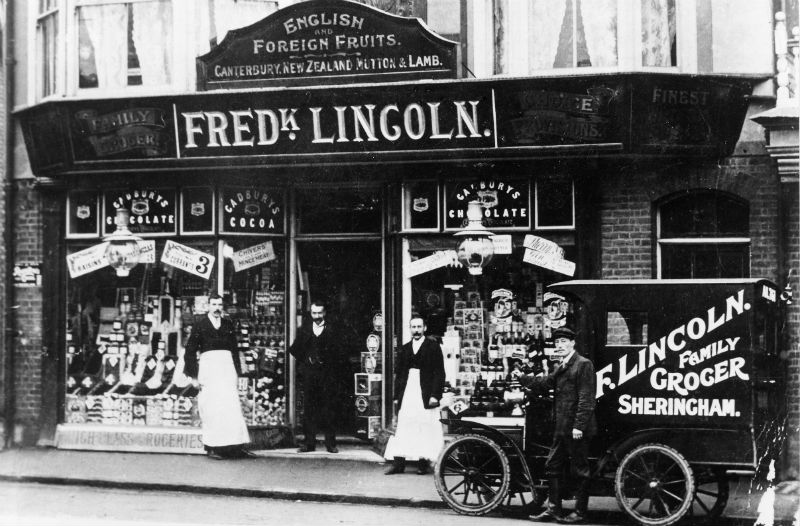
Shopping: admit it, we all love it. But going into a shop, picking something from the shelves, paying for it and being on our way was not how it was done not too long ago, believe it or not. Shops were usually family owned (specifically by the men of the family – although some widows could manage their husbands’ shops), and they hired young male apprentices who lived in the shop.  Why only men? Well… to put it bluntly it was believed that women were too stupid to do the math, too weak to be on their feet all day long, and that they lacked the competitive drive to run a business. Yeah, never mind that women usually didn’t receive education (specially not maths), and that it was thought to be “unlady-like” to be anything other than cute and pleasant, and that you had to wear corsets, crinolines and long skirts all day long, BUT HEY! Let’s just hire men, shall we?

Fred Lincoln victorian shop men

So, you come into a shop, entirely run by men (yes, even those selling trims and ribbons) and what could you expect to find? Well, for starters, goods did not have the price on them, so you had to ask… and haggle. The counters were high and every item was stored behind it. So if you wanted to see something you had to ask the shop keeper for it… and going into a shop and “just looking”? Good luck with that! You would get kicked out of the store for it. In fact, fancy shops had something called the “floorwalker” who would serve as a doorman and security guard. And if they noticed that you weren’t actually going to buy anything, they would ask you to leave not to keep wasting their time.

But! As industrialization kicked off cities started to grow and people began travelling around the world, and men in the working classes moved into new jobs in factories, which meant that there were more jobs available for women (other than service, agriculture and factories, which was the usual). In fact, in Britain there were more women than men, so with new jobs available single women on the working class could become, shock, self-supportive! And yet, a female shop assistant was paid half of her male counterpart’s salary. This wage gap comes from the principle that men were expected to support their entire family and women were expected to be kept by their husbands or just help make ends meet, at the most. And what about single mothers? Yeah, Victorians liked to ignore those as they were the incarnation of everything vicious and immoral.

Victorian shop shopgirl

Victorian shop, 1910

Industrial transformation also meant that there was a new spending population: the middle class was finally settling in, and they wanted to show off their wealth through consumer goods. I’m not going into this (not on this post anyway), but with industrial production and the discovery of new materials like cellulose, an entire industry based on knock off products emerged. You could now buy accessories that looked like expensive ivory or tortoise shell but were actually made of plastic, and they were dirt-cheap! Imagine that!

The new Department Stores

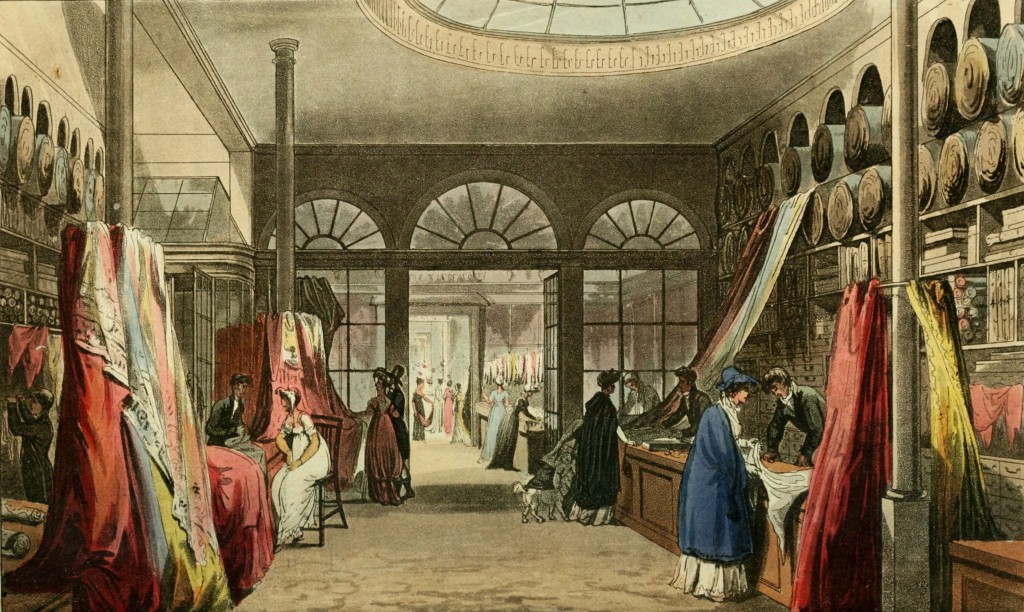
Harding, Howell, & Co's grand Fashionable Magazine, 1809

Harding, Howell, & Co’s grand Fashionable Magazine, 1809

The 19th century also saw the emergence of the consumer culture. Imagine living in a world where you could have every sorts of goods from around the world readily available! Ok, fine. We’re used to that by now. But back in the day you had to make dues with what was available to you, locally. But in came the Department stores: huge retailing palaces where you could find all sorts of items from anywhere you could imagine. Now there was no need for you to go door to door to find everything you were looking for, because now it was all under one roof. The world’s first department store was Harding, Howell & Co’s Grand Fashionable Magazine at 89 Pall Mall in St James’s, London (opened in 1796).

The department store was a safe place for Victorian women to both work and shop. Charles Jenner, founder of the Scottish Jenner’s department store, understood that women were key to his business. Dr. Cox worded it perfectly in her documentaries: he understood that “women should be at the center of his business, on both sides of the counter”. Middle-class women now had a safe place where they could spend their time of leisure, away from the company of men and unchaperoned. As shopping became more popular, society developed a dual (and hypocritical, if you ask me) view about women who did it: it was a woman’s duty to shop for her family (and even the men of the family) but she was criticized for wasting her time in the shops, and labeled as selfish and frivolous. Sounds familiar? Yeah, we still do that. Stop it. No, seriously, men like shopping just as much as women (even more in some cases), they actually spend more than women do, but it’s just that women have a different shopping experience than men and, most importantly, they’re buying for everyone else in the family. So knock it off.

Victorian Crinoline Dress

Princess Dagmar of Denmark wearing a crinoline in the 1860s.
That’s a lot of fabric!

So, part of the shopping experience was to have custom made clothing or partly-custom made clothing (that is, you would buy the different pieces separately and then have a seamstress put the garment together for you with your measurements – you could DIY if you were into that). In fact, fashion became a huge business by the mid-19th century as Queen Victoria and Empress Eugénie put the caged crinoline, and the enormous skirts that came with it, into fashion (seriously, the average skirt needed about 40 yards of fabric). And you don’t only needed huge dresses – you needed several of them as upper class women were expected to change at least once a day (usually for supper). There was a boom in the textile trade and everything related to it (dyes, needles, pins, ribbons, bleach, starch, etc.) and with better distribution systems shops could now offer a wider selection of goods brought from farther places, and they could also buy in bulk. And this meant that bigger retailers could reduce their prices much more than the traditional, smaller, specialist shops. Now, going to a store and paying for your goods in cash right then and there was not how business was ran – in fact, these traditional shops had accounts for their customers which were paid annually… which often sank them into bankruptcy. The emergent department stores now also dealt in cash, which meant they had a lot more buying power. You can imagine now how this became big business.

The emergence of the Shopgirl

Henry Siegel’s Department Store c. 1900, part of Ladies Mile at 14th Street and Sixth Avenue.

Henry Siegel’s Department Store c. 1900, part of Ladies Mile at 14th Street and Sixth Avenue.

SO! Onwards we go. The emergence of shopping required the equivalent of women shopkeepers. Why? Because it turns out that women preferred being assisted by women. Shopgirls were more attuned to the needs of the middle class women and were able to provide a better experience for them (and thus elevate their shopping fever – because if you’re having a good time you’re more likely to shop again). Also, retailing became the perfect job for lower middle class women. Remember what I was saying about there being more women than men? Well, that goes for all social classes. Now, a rich woman had little to worry about if she was single, as her own family could support her. And working-class women, as happened with lower classes since the dawn of time, worked as soon as they could – so when they reached an age where it was clear they were not going to marry, at least they had training and experience. But the lower-middle class woman was raised to be a wife and a mother, and if she didn’t marry she was left unskilled and with no income, and with no jobs prospect. So the Women of Langham Place set up an organization to provide the basic education for women and, yes, that included skills they could use for shop keeping. Hoorrah!

shopgirls portable shop seat victorian

‘A Portable Shop Seat’, a suggestion to help with the “standing evil” which caused maladies to shopgirls. Published on The Girl’s Own Paper, 1880.

But shop-keeping, although not as strenuous as factory jobs or farming, was very hard work. The hours were extremely long (back in the day there were no regulations as to how many hours someone was required to work, so they could work upwards to 100 hours a week), and they had to be on their feet all day long and would often go all day without eating. In addition to this, there was the living-in system: inheriting that old-age custom of having apprentices living in with the shop owners, shop assistants had to live either above the shop or nearby… and the expenses for living-in were taken out of their salaries (which was the perfect way to keep wages low). They even had fines for misconduct, which reduced their salaries even more (and that included fines for menial things such as having fresh flowers in their rooms). This meant that shopgirls (who were paid half as their male counterparts, don’t forget that), often had to turn to prostitution to make ends meet. Some reformers tried, but these conditions didn’t change until the 20th century (we’ll get there, if you’re still with me).

Here comes Selfridge’s

Opened in 1909 in London by Harry Gordon Selfridge, this department store would mark a before and after in the history of consumer culture. Harry was an American and had previously worked at Marshall Field’s where they pioneered in the policy of browsing. That’s right: you can thank him for now being able to say “no, I’m just looking” when you go into a shop and not being kicked out in the spot (he never hired floorwalkers). They also introduced the bargain basement, which was self-service at a time where customers had everything delivered to their house. He also brought the concept of providing customers with experiences and services not just goods: they had a restaurant, a reading room, a nursery for babies and, most importantly, A LADIES RESTROOM. Wait, what? Back in the day if you were a lady and wanted to go out shopping and maybe have a refreshment, you had to hold it in and go all the way back home if you needed to go to the toilet. Something as simple as that, and they were the first to think “well, if we want our customers to stay longer maybe we should give them a place to relieve themselves”. For him, shopping was also meant to be a pleasurable entertainment and so he focused on having well-informed, trained sales assistants who clearly loved where they worked.

selfridges couple advertisement

Selfridge’s advertisement

H. G. Selfridge was very progressive. He believed in the power of advertisement and the media: just spread the word to get customers through the door, and once inside we will give them comfort, courteous service and entertainment as an enticement to buy. In fact, he invested more money on advertisement than any other retailer of his era. And part of his discourse was advertising the novelty of his shop, like having electricity (in fact, he was the first to leave his windows light at night, which was the birth of “window shopping” as we know it), the telephone, the facilities I mentioned before (as well as hair salons, barbershops, post office, etc.), and even introducing in-store art exhibits and cookery demonstrations. He was also pioneer in the way he advertised: he wasn’t pushy about buying, but rather, he talked about the philosophy of shopping, inviting the customers to sightsee, and reassured the quality, comfort and convenience of his services, as well the fair prices and the fun the customers could have on his shop. For the opening he launched a campaign with 38 illustrated advertisements, including a quite controversial one with a couple dining in his restaurant. Scandalous.

Selfridges Elizabeth Arden cosmetics display nellie elt

Selfridge’s Elizabeth Arden cosmetics display, with Nellie Elt.

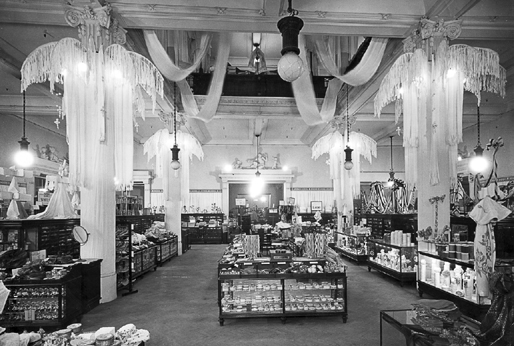
Selfridges store interior c 1910

Selfridge’s store interior, c. 1910

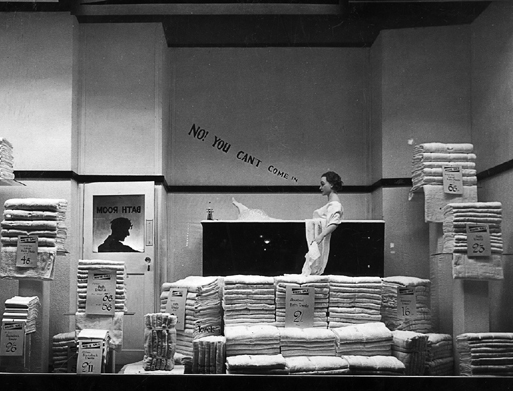
You know, when you go into a department store and the first thing you see is the perfume and cosmetics counters? Well, first one to do that was Selfridge’s. Back in Victorian times, the ideal of female beauty was very natural and clean, and make up (or at least obvious make up) was seen as very unlady-like so cosmetics were sold very discretely (after all, you weren’t really supposed to be wearing any). But with advances in technology not only cosmetics and perfume became more diverse, but they also became a lot more affordable with the dawn of synthetic chemicals. When Harry visited Paris in 1910 and saw that cosmetics and perfumes were openly on sale, he decided not only to expand Selfridge’s beauty department, but place it front and center – which was quite the shock to, well, everyone who hadn’t gone to Paris! Speaking of cosmetics and perfumes and shopping experience, Harry also believed that shopping should be “visual and tactile”, so he put central displays in the aisles with the merchandise which customers could touch, and he also lowered the counters to a “customer-friendly” level. In fact, he believed so much in this that Selfridge’s pioneered in the art of window dressing, introducing amazing, narrative displays that enticed the customers to look (and not just a pile of stuff, like it was customary at the time).

Selfridge's Bath Towels display Dialogue text reads: "No, you can't come in!"

Selfridge’s Bath Towels display
Dialogue text reads: “No! you can’t come in”

Selfridge's Elevator Girls

Selfridge’s Elevator Girls

Selfridge’s was also detrimental to working women, as they employed 2,000 shopgirls and lift-assistants, with wages slightly higher than elsewhere. He also parted from the live-in system and banished the concept of pay-bans. However, it must be said, none of his female employees reached executive levels. In his own words, he wanted to “make their life as happy as possible. Feed and pay them well. Make them contented. To grind the life and soul out of a miserable white slave is sheer and bad business policy”.

Shopgirls and the fight for rights

Now, I hope you’re still with me, because here comes THE PUNKNESS. Yes, Harry Selfridge also supported the Suffragettes, and advertised in Votes for Women magazine, promoting merchandise such as ribbons and accessories in their colors – so much so that in the famous protest of 1912, Suffragettes broke all the shop windows on Oxford Street but spared Selfridge’s. This gives me a smooth transition to talk about them, so shall we?

Embed from Getty Images
Margaret Bondfield Bassano

Margaret Bondfield by Bassano

First we have Margaret Bondfield who was a shopgirl at the age of 21. While working as a shopgirl in London, she realized the grim realities of the job: long hours, low pay, and the living-in system – basically, shops owned their female employees. So in 1891 (this is way before Selfridge’s) she joined the National Union of Shop Assistants to expose the injustices faced by shopworkers as an undercover reporter. She wrote a series about life in the shop, describing the conditions they had to live and work in, and how easily you could lose your job for breaking the rules. Although recruiting workers for Unions was risky (even more so for shopgirls), her articles were the first spark in a series of changes. She also was supportive of universal voting rights, and not only votes for property owner (a.k.a.: upper class) women, which was the suffragettes’ cause. Plus, she eventually became the first female cabinet minister in the UK!
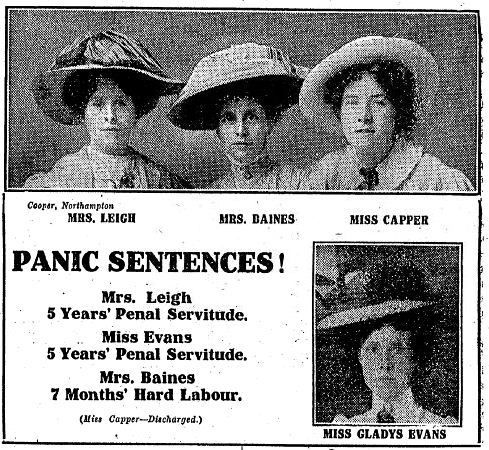
gladys evansThen we have Gladys Evans, who actually worked at Selfridge’s at 17, and recruited fellow shopkeepers into the Union. She was such a militant suffragette that she is most famous for traveling all the way to Dublin in 1912 and setting fire to the (empty) theater where Prime Minister Asquith was scheduled to give a speech the following day (he was famous for haaaating Suffragettes’ guts). She was arrested, given a five-year sentence (which was very harsh, given the circumstances) and she went on a hunger strike and was force-fed for 58 days. Her fellow employees at Selfridge’s even wrote letters asking for her freedom. PUNK ROCK!

selfridges delivery van women drivers

Selfridge’s delivery van during World War I, with women drivers

When the war came, shops across the country saw a shortfall in staff, which was made up by recruiting women: over half a million of them fled the servants’ quarters and sweatshops to work “man jobs”, including bus and ambulance driving, munition factories and even stoking the boilers. At Harrods 70% of the men had gone to war, so now they had women drivers and stock staff, and many other positions! In fact, women’s uniforms also became more utilitarian, and “[Harry G. Selfridge] also knew that his newly uniformed waitresses – now wearing trousers, could take ‘nine steps more per minute to get to the kitchen than they could in a skirt'”, noted in his diary in the 1920s. But more importantly all of this meant that women now had better wages and more spending power – even maids could now afford to go shopping as their wages doubled!

Embed from Getty Images

When the war ended, men got their jobs back, but the perception about working women had changed fundamentally. Now, no one could say that women couldn’t do men’s jobs, because they had just proved they could! More importantly, they now had new skills and were better prepared. In fact, women returning to their old jobs were able to demand better conditions by going on strike, which set the wheels in motion to what we now know as the 40-hour working week.

This is the fifth article on my series about Women in History. You can read the last one about Ada Lovelace here. Tell me who you think I should write about next!

Ada Lovelace, Math Witch and the World’s first Computer Programmer

Back in the 1800s there was a girl. A very smart girl. She was the daughter of the famous poet Lord Byron. And she would become the world’s first computer programmer… even if “computer programmer” was not a thing at the time, and even if we tend to forget about her today. Meet Augusta Ada Byron, also known as Ada King, the Countess of Lovelace, or simply: Ada Lovelace. You might ask yourself how is it that a lady in the middle of the 19th century managed to become a mathematician and a computer scientist before computers were a thing. Stay with me and you’ll see how.

Watercolor portrait of Ada King, Countess of Lovelace by Alfred Edward Chalon (1840)

Watercolor portrait of Ada King, Countess of Lovelace by Alfred Edward Chalon (1840)


Ada was the daughter of the brief marriage between Lord Byron and Anne Isabelle Milbanke. I’ll spare you the beef, but basically Anne separated Lord Byron shortly after Ada was born, he left for Greece and little Ada never met him. Anne also had a taste for mathematics, and Byron even called her his “Princess of Parallelograms” (and after they parted he referred to her as a “Mathematical Medea” – Medea was a sorceress in Greek mythology, which makes that pseudonym kind of badass if you ask me).

Lady Byron was intent on her daughter to be unlike her poetical (and quite controversial) father, so since a very young age she signed her up with a tutor to learn, among other things, mathematics and music. At age 12, little genius Ada decided she wanted to fly, so she wrote a book titled Flyology, with her research about flying and birds’ anatomy, illustrations, and the equipment she would need – she even built a prototype for a pair of wings and had the plan of integrating steam with the “art of flying”, as she called it.

Ada Lovelace Margaret Sarah Carpenter

Portrait of Ada Lovelace – Margaret Sarah Carpenter (1836)

At the time, there were no “professional scientists” as we know them today (in fact, the term “scientist” was coined by W. Whewell in 1836), but there were plenty of noblemen and noblewomen doing their own research. Although women were not allowed to attend University or private clubs where much of the scientific research and discussion was done, they were allowed to attend public lectures, which Ada attended often.

Enter Charles Babbage, professor of mathematics at Cambridge, known as the inventor of the Difference Engine, a very elaborate calculating apparatus, and “the father of computers”. Mary Somerville (noted researcher, mathematician and scientific author, whom I hope to write about in the future), Ada’s tutor, introduced Ada and Babbage in 1833 at a party, where Babbage gave her a demonstration of a small working section of his Engine. This was the beginning of their friendship and professional relationship – Babbage was so impressed by Ada that he would call her “The Enchantress of Numbers” (see? The Byrons were a family of Math Witches). Babbage had made plans for a new machine, the Analytical Engine, and that’s where their collaboration began.

Babbage Analytical Engine

A portion of Babbage’s analytical engine built in 1871

So, what are these engines I speak of? At the time, these “engines” were some sort of giant, mechanical calculators. The Difference Engine was a machine designed to perform mathematical computations and storing numbers, and yet it could only apply finite differences. The new Analytical Engine was thought to be a machine that could compute with general information after being programmed – meaning, to act on general instructions (supplied through operation cards), without the need of a human programmer to set the initial values to enter data. The Analytical Engine was never built because it was too expensive. Now, I’m oversimplifying what the machine was able to do because it was a very complex piece of equipment. So complex, in fact, that Babbage always had trouble to fully explain what it could do. And that’s where Ada comes in.

In 1840, Babbage was invited to give a seminar in Italy about his Analytical Engine, where his lecture was transcribed and published in French (in 1842). Ada was commissioned with the translation of the paper into English – but she went well beyond that. She augmented the paper with notes that were about three times longer than the original publication and included the description of the Engine, a set of instructions, and her own speculations of its possible uses. These notes were later published in Taylor’s Scientific Memoirs under the initialism AAL, and it was not until 1953 when her notes were republished. More importantly, she became a vocal advocate of Babbage’s ideas, at a time where society didn’t really pay attention to his research.

So, why is Ada’s work so significant? Why are these notes so important? First of all, she was able to do something Babbage found very difficult to do for himself: actually explain what the machine did, and how it differed from the previous Difference Engine. In note G, she gives what is considered the first program in history to be implemented on a computer, using an algorithm for the Analytical Engine to compute Bernoulli numbers. Ada went even further than that and speculated how the Analytical Engine would be capable of giving not only numerical results, but also symbolic, and how it was able to store both data and a sequence of instructions or, as we would call it today, a program. This was a huge conceptual leap: a machine that could solve problems of any complexity and do other things beyond calculating! She understood the potentials of a computing machine at a time where these were seen as merely calculating tools (a vision held by Babbage himself). She envisioned computers being used to compose complex music, produce graphics, and being useful not only for scientific purposes but for practical purposes as well. Sounds familiar? Well, that’s what modern computers do.

Ada hoped to be an “analyst and metaphysician” and she often talked about “poetical science”. This very particular point of view is what helped her conceive computers and their functions with imagination, in a human context. She valued metaphysics as much as mathematics, viewing both as tools for exploring “the unseen worlds around us” and applying imagination to science.

Google Doodle for Ada Lovelace’s 197th birthday

Google Doodle for Ada Lovelace’s 197th birthday

Isaacson sums up Ada Lovelace’s contributions into four essential concepts that would be the foundations of modern computers: 1) the idea of a general-purpose machine, able of reprogramming and an unlimited range of operations; 2) the idea that such a machine could go beyond mathematical calculations, capable of processing any piece of content, data or information and express them in digital form – this was the conceptual leap we were talking about above; 3) the step-by-step outline of  “the workings of what we now call a computer program or algorithm”; and 4) to question whether machines could think independently, to which she concluded that no matter how powerful a computer could be, it would never be a “thinking machine” (over a hundred years later we haven’t proved her wrong – yet?).

As you can see. Ada’s contributions are huge. Alan Turing, known as the “father of modern computers”, was inspired by Lovelace and implemented symbols to the Colossus and made explicit references to her Notes in his works. Throughout her life, she was very interested in science and discoveries of the era, and she even had plans to create a mathematical model for how the brain’s thinking process works.

Unfortunately she died at the age of 37 of uterine cancer (and after a long history of illnesses that didn’t stop her research) and we are now deprived of her research. Some refer to her as the “prophet of the computer age” – and I happen to think this is very fitting.

This is the fourth article on my series about Women in History. You can read the last one about Cipe Pineles here. Tell me who you think I should write about next!

Cipe Pineles, and the modern magazine layout.

Unless you’re REALLY into design (and not only creation but its history) you probably have never heard about Cipe Pineles. Which kinda sucks, because we owe to her modern layout design that focuses on narrative and integrating text and images. So, who is she? Gather ‘round, kids! It’s time to meet good ol’ Cipe.

Once upon a time, Cipe was just an illustrator recently graduated from the Pratt Institute. She was 20 years old and she walked around New York City trying to sell her paintings of Coca-Cola bottles and sandwiches. Little did young Cipe know that she would eventually become the art director for Glamour (in 1942), Seventeen (1947) and Charm (in 1950). Until her death in 1991, her career in design had lasted almost sixty years! So, how did she manage to do that?

Cipe Pineles

Cipe Pineles at Condé Nast

DSC_2665_0_0You could say her career to the top began when she was hired by Condé Nast himself after catching his interest with some store window fabric displays she had developed for Contempora (the first job she had since graduating). She would then come to work for M. F. Agha, the art director for Vogue, Vanity Fair and House and Garden. This job trained her on everything she would need to know for her future art director roles. Under Agha’s direction during the 30s, Condé Nast publications would incorporate the use of European Modernism into innovative magazine design. Typography was simplified (say hello to Futura font) and elements on the page were revolutionized: photography became more prominent over illustration, printed on a larger scale, and “bleeding off” to transgress across the gutter; headlines and text could now be anywhere on the page and space expanded to give more room to margins.

Pineles remembers her work for Agha fondly: “Agha was the most fabulous boss to work for. […] Nothing you did satisfied him. He was always sending you back to outdo yourself, to go deeper into the subject. […] He spent a lot of time talking with his creative people about problems related to type. Pictures and the selection of pictures as satisfying an editorial concept or not.”

DSC_2660After becoming art director for Glamour and World War II, she became the art director for Seventeen magazine. This publication was radical in its own accord: it targeted an ignored and undefined audienceteenage girls. Cipe and Helen Valentine, founder and editor, saw their readers not as silly children, but as smart, serious young adults. Valentine wanted to use her platform to educate teenage girls, and Pineles went right ahead and hired the best contemporary artists working in America at the time. Seventeen’s success was based on Helen Valentine’s conviction that teenage girls represented a significant economic force, and on her ability to convince advertisers to support the magazine that reached them. Pineles made Seventeen visually elegant and lively.

And here lies one of Pineles’ greatest innovations as an art director: she was the first to use fine artists to illustrate mass-market publications, bringing contemporary art to the eye of the young, mainstream public while also giving fine artists access to commercial work. As an artist and illustrator herself, she knew the best way to work with artists: she asked them to read the whole story, choose what they wanted to illustrate… and then she left them alone! “Her only direction was that the commissioned work be good enough to hang with their other work in a gallery”.

As for Pineles’ own artwork, there’s a famous anecdote with potatoes: the food editor found potatoes too ugly to go with her story, so she asked for Cipe’s help. “I thought they were pretty, so I dug out my kitchen tools, bought ten cents’ worth of potatoes, painted them on a double-page size sheet of paper, indicated the type layout and left town. Total time, an hour and a half. Two weeks later, when finished art was needed, I went about the job more seriously. I nursed the potatoes, considered the type more carefully, and then tore the whole thing up. The rough was more fun. Total time, eighteen hours.”

Seventeen, February 1948, pp. 90–91.

Seventeen, February 1948, pp. 90–91.

… She won a gold medal at the Art Directors Club for the potato spread.

Among other achievements, she used objects to replace letters as visual puns, which would later become known as the American figurative typography trend. At Charm she would often make fashion spreads of women at work, showing clothes for working women… in use, on location! This was addressed to the new, professional women, who were interested in beauty and fashion, as always, but also in their professional careers and their new place in the world.

Unlike most men and women in graphic design, Pineles attained, for a time, a position to shape and promote her vision, and she gained a measure of recognition unusual for any graphic designer and extraordinary for a woman

Seventeen, April 1950s pp. 104–5. Illustrated by Dong Kingman

Seventeen, April 1950s pp. 104–5. Illustrated by Dong Kingman

She is accredited as the first independent woman American graphic designer, the first woman to join the Art Directors Club, and has awards from ADC, AIGA, Society of Publication Designers and others and she taught editorial design at Parsons until the mid-80s.


This is the third article on my series about Women in History. You can read the last one about Joan Clarke and the women of Bletchley park here.

Joan Clarke, the cryptanalyst war-heroine, and the women of Bletchley Park (you never heard of)

Even if you’re not a History Buff, D Day is a term that rings the bell, right? June 6th, 1944, the Allied troops land on Normandy to fight the Nazis and begin the (cleverly named) Battle of Normandy. This resulted in the liberation of Western Europe from Germany’s control and the eventual Allied victory. Hoorray!

What you may not know, is that there was an extensive intelligence effort behind this battle, most of which happened on Bletchley Park. This was the central cite of the UK’s GC&CS (Government Code and Cypher School), tasked to penetrate secret communications of the Axis Powers. Some historians have estimated that the work done by the British Intelligence at Bletchley Park shortened the war by two to four years, and was a key element to the Allies’ success.

Bletchley Park Women working on computer

Young Joan Clarke in uniformNow: what if I told you that the Bletchley Park personnel was 75 % – 90% made up by WOMEN? And what if I told you that one of those women was part of the The Hut 8 team? Meet Joan Clarke, the woman who worked side by side with Alan Turing and Hugh Alexander on breaking the German cipher system Enigma (and succeeded).
Let’s break it down: the Germans had something called The Enigma Machine that encrypted their messages into code. Not knowing the settings meant the chances of being able to decipher a message was an astonishing 150 million million million to one. Talk about a high pressure job, right? But breaking the Enigma code was not a single-man (or single-group) task: it required constant contribution from a large personnel (over 10,000 people) including, in addition to cryptanalysts, clerks, machine operators, and intelligence and communications workers.

Joan had a double first degree in mathematics (she was denied a full degree by Cambridge because, until 1948, those were only awarded to men). Even though her promotion to Hut 8 was significant, because she was the first and only senior female cryptanalyst, bureaucracy had no protocols to give her a raise. Thus, she was classed as a linguist and from there on she filled the forms with “grade: linguist, languages: none” (and even then she was paid less than her male colleagues).

Naval Enigma (codenamed Dolphin) was more complex to break than the others, as there were more variables to the codes. The Hut 8 team worked on codes related to U-boats intelligence, that is, German ships hunting down (and sinking) Allied vessels carrying supplies and troops from the US to Europe. Britain at the time was importing half of its food and all of its oil from North America. After the German occupation of France, German ships had easy access to the Atlantic through the Bay of Biscay. The situation was dire: at one stage, Britain was only three days from running out of food.

Alan Turing had invented a new codebreaking technique called Banburismus that allowed to narrow down the possible code combinations from 336 to 20. Joan was not only the only female Banburist, but she was also one of the best. She devised a method of her own to speed up the technique. But to her surprise she was told she was using a technique called Dillysimus, devised in WWI (and it is thought that the reasons for not naming this improvement after Clarke were, certainly, sexist). Other women codebreakers included Mavis Lever, Ruth Briggs, Dilly Knox and Margaret Rock. But unfortunately little is known about their work as their contributions are hardly noted anywhere.

Joan Clarke Hut 8 team

Joan Clarke and the Hut 8 team, 1946 (I really wish this picture was larger)

Most importantly, all this code-breaking and cryptanalysis resulted in the first programmable computer, Colossuswhich was operated by women (click on that link for awesome then and now photos). Historical memory has not been fair to the civilians and service women of Bletchley Park. They are (and were at the time) commonly referred to as the ‘girls’ of Bletchley Park. The extreme secrecy around War Intelligence has prevented formal research until recently, so we might have to wait before we see significant work about these war heroines.

Joan_Clarke_Bletchley_Park_Women

Never the less: you have Joan and the women of Bletchley Park to thank for changing the History of the World AND the fact that you’re reading this on a computer!

This is the second article on my series about Women in History. You can read the first one about Sor Juana Inés de la Cruz here. Tell me who you think I should write about next!

Sor Juana, the Nerd-Punk

Let me tell you about Sor Juana Inés de la Cruz. First: SHE’S PUNK ROCK, OK?! But she’s also A HUGE NERD. Now, stay with me and I’ll tell you all about her.

The Nerd:

After she learned to read when she was three (without her mom’s permission) she became so adamant about learning that she would CUT HER HAIR as a self-punishment if she hadn’t studied enough. By the age of eight she had written her first poem and won a contest for it (most 8 year olds have barely mastered the art of not wetting the bed, and this kid was winning literary contests). Eventually she was sent to the capital to live with her aunt and went to court.
The court was THE place to be if you were an intellectual. Ex alumni and professors from the University of Mexico just hung out and had all sorts of smart talks. Of course Juana, the nerd, was like a fish in the water and bloomed in this environment and wrote poems that were really liked at court. She became so well versed that she was a bit of a celebrity and the Viceroy had a group of erudite men question her about a number of topics and she passed with flying colors. And she was 17. Yeah, 17. The Vicereine became so impressed and intrigued that she made her one of ladies in waiting and became her protector.

She really wanted to dedicate her life to studying, but only men could go to university (to which she told her mom before going to court “just let me dress like a man and I’ll go!”, and mom replied “OH HELL NO” — this is not an actual quote). While in court, father Núñez de Miranda (remember this guy), the Viceroys confessor, saw her thirst for knowledge and suggested for her to go to a convent. Juana admitted she was not really interested in love (maybe she was asexual?) so she became a nun, to have access to books and MORE KNOWLEDGE. However, she was not the best nun: she first joined the Carmelites, but they were way too strict and she got sick. She then transferred to the order of Saint Jerome where she could have a two story cell and maids! Plus, she was allowed to study, write and, most importantly, have visitations. And despite all of these perks, she always found her nun-chores to be such a drag because she only wanted to study.
She constantly had intellectuals and nobles over (Party at Juana’s!), and in her cell she did scientific experiments, wrote music, and wrote… a lot. A LOT. Her entire body of work includes poetry, plays (which apparently where hilarious), and philosophical and musical essays. The Vicereine even managed to take Juana’s books to Spain and publish three whole volumes. This was not the same Vicereine she waited on, this was her successor, María Luis Manrique de Lara y Gonzaga, and they were totally bffs: the Vicereine even had a ring Sor Juana had given her and a portrait of her.


The Punk

Ok, so, to recap: this bastard child coming from a family that was not particularly well-off or had noble titles just made her way to the nunnery and is doing what she loves, studying. But there’s more to Sor Juana: she was also a business woman. She was smart enough to play the game while she was at court and she made a lot of useful contacts that would help her for the rest of her life (like both the Vicereines). She made friends with Pedro Velásquez de la Cadena, who actually paid for the dowry for her to become a nun. She was also paid for her writing (which might be how she got all her books and trinkets). The most notable case is the «Allegory to Neptune» and the monumental arch to welcome the new Viceroy and Vicereine, for which she was paid 200 pesos. To top it all off, she was the treasurer for the Saint Jerome monastery and they had silver investments, and it was found after her death she had 2,000 pesos deposited with a merchant (and the convent had to work like crazy to get the money back, but they succeeded).
She was also a smartass. She knew she was smart, and she criticized famous works, like Petrarch’s poems (enough with sun-hairs, pearl-teeth and rose-lips! We get it Petrarch!). And this is exactly what got her in trouble. You might have heard of Sister Philotea’s letters (or maybe not, but don’t despair, I’m here to explain)… so here’s the dirt. Antonio Vieira made a sermon about “Christ’s finesses”, and Juana didn’t like it so she wrote a letter to Manuel Fernández de la Cruz, Puebla’s Bishop, tearing the whole thing down (through private correspondence). But Bishop Manuel here was a back stabber and actually published Juana’s letter with his own commentary (called Carta Atenagórica). But he couldn’t show his face, oh no, he signed as Sister Philotea. And what was his commentary? “yah Juana, you might be smart, but you should stick to nun stuff because you’re a woman, and only men discuss these matters”. OH HELL TO THE NO NO! Juana, the punk, wouldn’t have this and she published her famous Reply to Sister Philotea de la Cruz (see how she added Manuel’s last name?) defending women’s right to study (excerpt below). But Douche-Bishop Manuel was joined by father Núñez de Miranda (remember him?) and Archbishop Aguiar y Seijas, who took the chance to fan the flames that would result in Juana’s demise. Rumor has it that father Núñez was kind of jealous of Juana’s pseudo-celebrity status and that Aguiar y Seijas was a fanatic.
During Juana’s final years, there’s a radical change: she sold all her books, instruments and scientific trinkets, stopped writing and dedicated herself to the convent life. There are two interpretations of this: 1) the church says Juana had a sudden revelation thanks to father Núñez confession and that she was doing penitence through piousness, after doing three “blood vows” (her last publications) or 2) she was forced to give up all her stuff and do nun-appropriate activities (and kept writing and studying in private). As a final FU, there is a remaining convent book where she signed “I, the worst of all women” WITH BLOOD (I like to think she was being sarcastic because she was still going through prosecution).
In 1695 a terrible pestilence broke out and she died at the age of 43, leaving behind 180 books (yeah, after giving most of her library away) to her family.

And here’s the excerpt of her defending women’s education:

In another passage, Mulier in silentio discat—which passage is more for women than against them—women are ordered to learn, and of course women must keep quiet while they are learning. It is also written, Audi Israel, et tace. Here it speaks with the entire community of men and women, and it orders all of them to be quiet, for it is right for those who hear and learn to pay attention and keep quiet. And if this isn’t so, I would like those interpreters and exegetes of St. Paul to explain to me how they understand the passage, Mulieres in Ecclesia taceant. Because either they must understand it in the physical sense of pulpits and professors’ chairs, or in the formal sense of the universality of all believers, which is the Catholic Church. If they understand it in the first sense, which is its true meaning, in my view, then we see that, in effect, it is not permissible for women to read or preach in the Church. Then, why do they scold women who study in private? And if they take the latter position and they want the Apostle’s prohibition to apply absolutely so that women are neither permitted to study nor to write in private, then how is it that the Church has allowed women like Gertrude or Teresa or Birgitta or the nun of Ágreda or many others to write? And if they tell me that these women were saints, that’s so, but that does not go against my argument […]

Therefore, if the evil lies in verses being used by a woman, we have already seen how many women have used them commendably. Then, what is the problem with me being one? Of course, I confess my baseness and my base, vile nature; but I maintain that no one has ever seen an indecent poem of mine. Moreover, I have never written anything of my own volition, but rather at the request or directive of others.


This is the first on a series about Women in History. Let me know if you like it and who I should talk about next!